
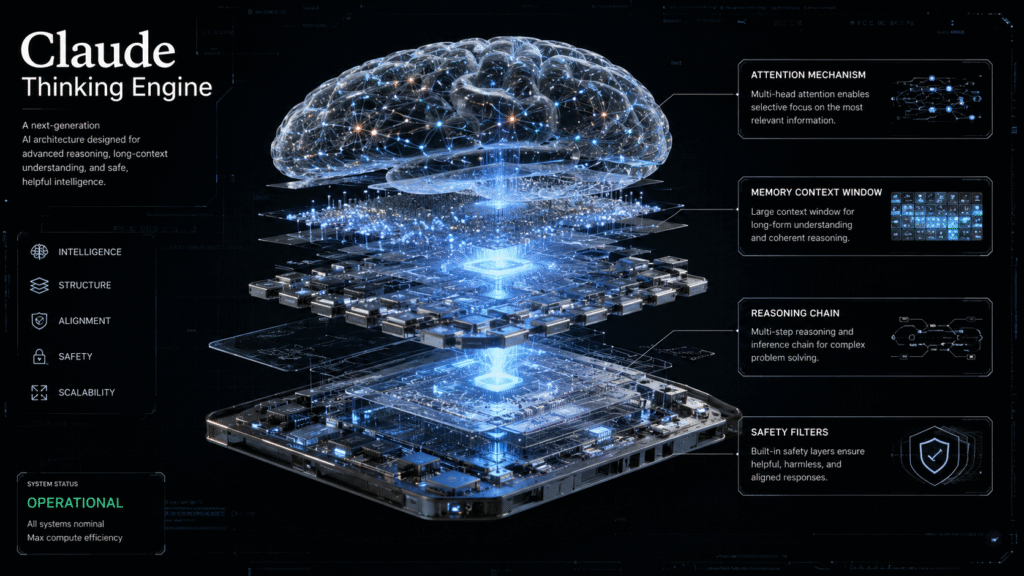
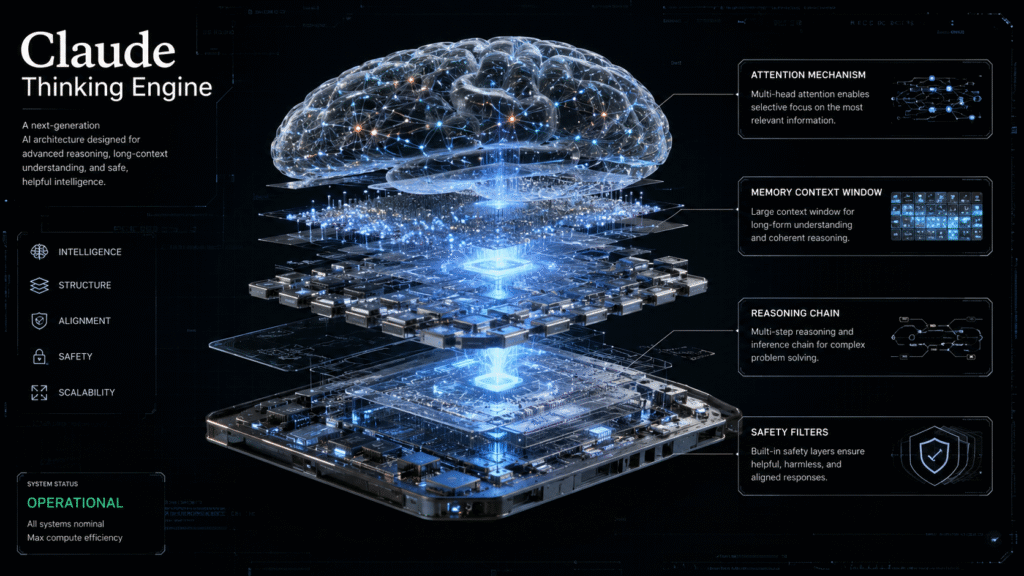
Claude Architecture Explained
A deep dive into what actually makes Claude tick from raw transformer math to the ethics baked into its training.
Claude Is Not One Thing. It’s Many.
Most people think of Claude as a chatbot. Type something in, get a smart answer back.
That framing misses almost everything interesting.
Claude Architecture Explained is a layered system, a stack of architectural decisions, training choices, safety mechanisms, and behavioral guidelines that have been assembled over years of research. Understanding how it works isn’t just an academic exercise. It changes how you use it, how you build with it, and how you think about AI in general.
This article breaks down 62 core components across 7 layers of Claude’s architecture, from the raw transformer mechanics at the bottom to the product-level features at the top.
Let’s go.
Claude Architecture Explained:
Layer 1: The Foundation — Transformer Architecture (Components 1–10)
Everything starts here. Claude, at its core, is a decoder-only transformer, the same architecture class as GPT-4, Llama, and Gemini. What makes it different is everything built on top of this foundation.
1. Decoder-Only Transformer Stack Claude uses a causal (decoder-only) transformer, meaning it generates text one token at a time, left to right. Each token is predicted from all the tokens before it.
2. Self-Attention Mechanism The attention mechanism lets the model weigh the importance of every previous token when generating the next one. This is what allows Claude to “remember” something said 10,000 tokens ago.
3. Multi-Head Attention Attention runs in parallel across multiple “heads,” each learning to focus on different relationships: syntax, semantics, and long-range dependencies simultaneously.
4. Feed-Forward Sublayers After attention, each layer passes representations through a feed-forward network that transforms and enriches them. Think of this as where individual token meanings are processed.
5. Residual Connections Each layer adds its output to its input (a “skip connection”). This prevents information loss in deep networks and makes training dramatically more stable.
6. Layer Normalization Applied before or after each sublayer to keep activations in a healthy numerical range throughout training. Without this, deep networks become untrainable.
7. Causal Masking During training, Claude cannot “see” future tokens: each position only attends to past positions. This is what makes autoregressive generation possible.
8. Token Embeddings Raw text is first converted into numerical vectors (embeddings). These vectors capture semantic meaning words with similar meanings cluster together in embedding space.
9. Positional Encodings Transformers have no built-in sense of sequence order. Positional encodings inject information about each token’s position in the sequence.
10. Output Projection Layer The final layer maps the model’s internal representations to a probability distribution over the entire vocabulary, predicting which token comes next.
Layer 2: Scale and Training Infrastructure (Components 11–20)
Raw architecture only gets you so far. Claude’s capabilities come from training at scale on massive datasets, with enormous compute, using carefully engineered pipelines.
11. Pre-Training Data Corpus Claude was trained on a vast dataset of text from the internet, books, code, scientific papers, and more — likely trillions of tokens. Anthropic has not fully disclosed the data composition, but data quality is treated as a first-class concern.
12. Data Filtering Pipeline Not all internet text is equal. Anthropic applies filtering to remove low-quality, harmful, or duplicated content before it ever touches the model during training.
13. Tokenizer (BPE) Claude uses Byte Pair Encoding (BPE), a subword tokenization method that breaks text into efficient chunks. A well-designed tokenizer affects both performance and the model’s ability to handle rare words and multiple languages.
14. Large-Scale Distributed Training Training frontier models requires thousands of GPUs or TPUs running in parallel. Anthropic uses distributed training infrastructure across clusters, coordinating gradient updates across hardware at massive scale.
15. Mixed Precision Training Using 16-bit floats where possible (instead of 32-bit) dramatically reduces memory requirements and speeds up training — without meaningfully degrading model quality.
16. Gradient Checkpointing A memory optimization technique that trades compute for memory by recomputing intermediate activations during the backward pass rather than storing them all.
17. Learning Rate Scheduling The rate at which model weights are updated follows a careful schedule typically warming up, then decaying. This affects both training stability and final model quality.
18. Model Parameter Scale Anthropic has not published exact parameter counts for Claude 4, but frontier models typically operate in the hundreds of billions of parameters. Scale is one of the strongest drivers of capability.
19. Compute Budget Allocation How much compute goes to training vs. inference vs. safety research is a strategic decision. Anthropic’s safety-first philosophy influences how compute is prioritized.
20. Knowledge Cutoff Management Claude’s pre-training data has a cutoff date. Managing this and being honest with users about it is an architectural and behavioral design decision.
Layer 3: The Alignment Stack — Constitutional AI (Components 21–32)
This is where Claude diverges most sharply from other AI systems. Anthropic’s core contribution to AI alignment is Constitutional AI (CAI), an approach that bakes ethics into the training process itself, rather than bolting it on afterward.
21. The AI Constitution A written set of principles that guide Claude’s behavior. Anthropic’s constitution draws from the UN Declaration of Human Rights, Apple’s terms of service, DeepMind’s Sparrow Principles, and more, attempting to capture diverse ethical perspectives.
22. Supervised Fine-Tuning (SFT) After pre-training, Claude is fine-tuned on curated examples of high-quality, helpful, and safe responses. This shapes the model’s baseline behavior before alignment training begins.
23. Self-Critique Loop The model generates a response, then critiques it against constitutional principles, then revises it. This generates alignment training data without requiring a human annotator for every example, a key scalability win.
24. RLAIF (Reinforcement Learning from AI Feedback) Instead of relying solely on human preference labels, Anthropic uses AI-generated feedback (guided by the constitution) to train the reward model. This is the “AI” in Constitutional AI.
25. RLHF (Reinforcement Learning from Human Feedback) Human evaluators also rate model outputs, providing preference data that trains a reward model. Claude uses a combination of RLAIF and RLHF, getting the benefits of both.
26. Reward Model A separate model trained to predict which responses humans (and AI evaluators) prefer. This reward signal guides the main model’s behavior during RL training.
27. Preference Optimization The main model is updated to generate responses that score highly on the reward model — producing outputs that are more helpful, honest, and safe.
28. Helpfulness Objective One of Claude’s three core behavioral objectives. Being genuinely useful to the person you’re talking to not in a watered-down, hedge-everything way, but substantively helpful.
29. Harmlessness Objective Claude is trained to avoid producing outputs that could cause real-world harm to the user, to third parties, or to society. This includes refusing dangerous requests and adding appropriate caveats.
30. Honesty Objective Perhaps the most interesting of the three. Claude is trained to be truthful, to acknowledge uncertainty, to avoid manipulation, and to be calibrated — not expressing more or less confidence than it actually has.
31. Instruction Following Claude is trained to follow user instructions accurately, understanding what’s being asked, even when it’s complex, ambiguous, or requires reasoning across a long context.
32. Refusal Calibration Getting refusals right is genuinely hard. Too many refusals and the model is useless. Too few and it’s dangerous. Claude is specifically trained to calibrate this refusing things that actually require refusal, and helping with things that don’t.
Layer 4: Context and Memory Architecture (Components 33–40)
A model’s ability to maintain context over long interactions is a fundamental architectural constraint. Claude’s context handling has become one of its strongest differentiators.
33. Context Window Claude supports up to 200,000 tokens of context roughly 500 pages of text. This isn’t just storage; the model must attend to and reason across the entire window coherently.
34. Long-Context Attention Optimization Standard attention scales quadratically with sequence length, making very long contexts computationally expensive. Anthropic uses architectural optimizations to make 200K tokens tractable.
35. In-Context Learning Claude can learn from examples provided in the prompt itself without any weight updates. Providing a few well-crafted examples can dramatically improve output quality for specific tasks.
36. System Prompt Processing A special context slot that sets up Claude’s persona, instructions, and constraints for a given deployment. Operators use this to customize Claude’s behavior for their specific use case.
37. Projects and Persistent Memory At the product level, Claude can maintain memory across conversations within a project, storing user preferences, context, and history. This is built on top of RAG (Retrieval-Augmented Generation) for large knowledge bases.
38. RAG (Retrieval-Augmented Generation) For large knowledge bases, Claude automatically switches to RAG mode, retrieving relevant chunks of information rather than stuffing everything into the context window at once.
39. Conversation History Management In long conversations, managing what stays in context vs. what gets summarized or dropped is an active architectural challenge. Claude handles this gracefully, maintaining coherence across extended interactions.
40. Multi-Turn Coherence Claude maintains consistent behavior, memory of earlier statements, and logical coherence across long, multi-turn conversations not just within a single response.
Layer 5: Reasoning and Thinking Systems (Components 41–48)
One of the most significant recent advances in Claude’s architecture is the addition of explicit reasoning capabilities, the ability to “think before answering.”
41. Extended Thinking / Chain-of-Thought Claude can be configured to reason through problems step by step before producing a final answer. This dramatically improves performance on complex math, logic, and multi-step problems.
42. Adaptive Reasoning Claude automatically adjusts reasoning depth based on problem complexity spending more compute on hard problems and less on simple ones.
43. Self-Consistency For hard reasoning tasks, Claude can generate multiple reasoning paths and check for consistency, a technique that improves reliability on complex problems.
44. Tool Use / Function Calling Claude can call external tools web search, code execution, APIs, and incorporate the results into its reasoning. This transforms it from a static language model into a dynamic agent.
45. Code Execution Environment Claude can write and run code, observe the output, and use that output to inform its next steps. This is crucial for tasks involving data analysis, math, and debugging.
46. Planning and Task Decomposition For complex agentic tasks, Claude can break a goal into subtasks, plan an execution sequence, and work through it checking results at each step.
47. Multi-Agent Coordination In agentic deployments, multiple Claude instances can coordinate one acting as an orchestrator, others as specialized subagents handling specific subtasks.
48. Uncertainty Quantification Claude is trained to know what it doesn’t know expressing calibrated uncertainty rather than hallucinating confident-sounding nonsense.
Layer 6: Safety and Behavioral Guardrails (Components 49–56)
Safety isn’t a single feature in Claude it’s a system of overlapping mechanisms across training, inference, and deployment.
49. Hard Limits (Absolute Restrictions) Certain behaviors are never permitted regardless of context helping create weapons of mass destruction, generating CSAM, and a small number of other absolute limits. These are non-negotiable.
50. Soft Defaults (Adjustable Behaviors) Many behaviors are on or off by default but can be adjusted by operators for legitimate use cases. For example, explicit content is off by default but can be enabled by adult platforms with appropriate controls.
51. Operator Trust Hierarchy Claude treats operators (companies deploying it via API) differently from end users, with different levels of trust and different abilities to customize behavior. This creates a layered permission system.
52. Prompt Injection Resistance Claude is trained to resist attempts to override its instructions through cleverly crafted user inputs a critical security property for agentic deployments.
53. Jailbreak Resistance Anthropic continuously red-teams Claude and updates its training to resist known jailbreak techniques roleplay gambits, multi-step social engineering, and other manipulation attempts.
54. Dual Newspaper Test An internal heuristic Anthropic uses: would this response be reported as harmful by a journalist covering AI harms? Would it be reported as needlessly unhelpful by a journalist covering paternalistic AI? Claude aims to pass both tests.
55. Interpretability Research Anthropic is a leading researcher in mechanistic interpretability understanding what’s actually happening inside the model’s computations. This research informs safety work and helps identify failure modes.
56. Red-Teaming and Adversarial Testing Before each major release, Anthropic runs extensive red-teaming dedicated teams trying to find harmful capabilities or safety failures. This shapes the final training and deployment decisions.
Layer 7: Product and Deployment Layer (Components 57–62)
The final layer is where Claude’s architecture meets the real world the infrastructure and product decisions that determine how the model reaches users.
57. Model Tiers (Haiku / Sonnet / Opus) Anthropic ships multiple model sizes optimized for different cost/capability tradeoffs. Haiku is fast and cheap, Sonnet is balanced, Opus is the most capable. Each has different architectural properties.
58. Multi-Platform Deployment Claude runs on the Anthropic API, AWS Bedrock, and Google Vertex AI giving enterprises flexibility in where and how they deploy. This is a strategic product decision as much as an architectural one.
59. Inference Optimization Serving a model this large at scale requires careful inference optimization batching, caching, quantization, and other techniques to keep costs and latency manageable.
60. KV Cache The Key-Value cache stores attention computations from earlier parts of a conversation so they don’t need to be recomputed on every token dramatically improving inference speed for long contexts.
61. Streaming Responses Claude streams tokens as it generates them rather than waiting to send the full response. This is a UX decision that makes the model feel faster and more interactive.
62. Claude’s Model Spec Perhaps the most unusual component in this list: Anthropic publishes Claude’s “model spec” a detailed document describing the values, priorities, and behavioral principles it’s trained to embody. It’s not code. It’s closer to a constitution. Making this public is itself an architectural decision about transparency, accountability, and what it means to build AI responsibly.
What This All Adds Up To
Run through all 62 components and a picture emerges: Claude is not a single technology but an integrated system where capability and safety are designed together, not traded off against each other.
The transformer architecture gives Claude language ability. The Constitutional AI stack gives it values. The context architecture gives it memory. The reasoning systems give it thought. The safety mechanisms give it judgment. And the deployment layer is what makes all of it usable.
Most AI products let you interact with one part of this stack the output. Understanding all 62 components is what separates developers who use Claude from developers who truly know how to build with it.
Last updated: May 2026. Claude’s architecture evolves with each new model release.
Contact us –
contact link – click here
website link – click here